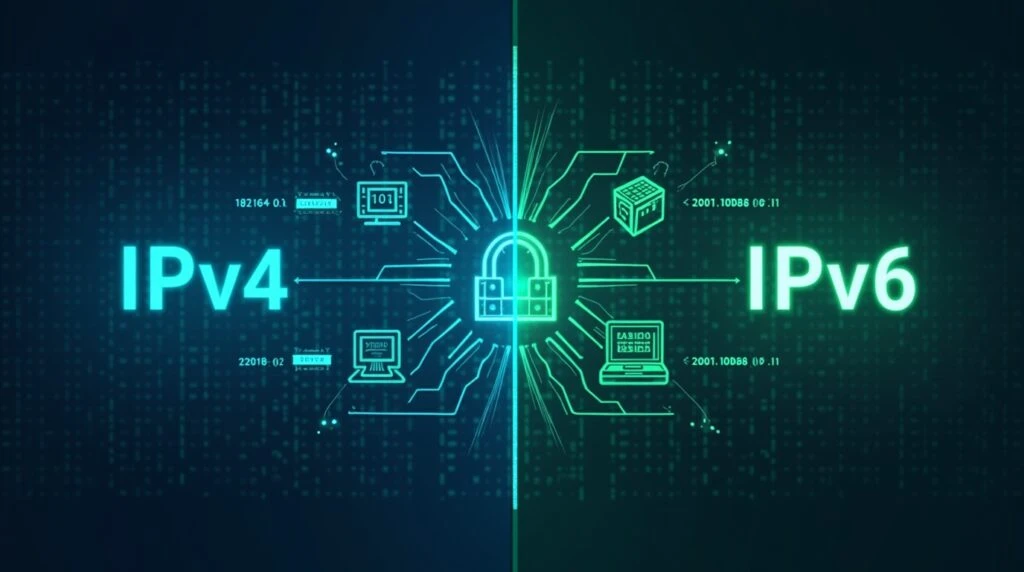
IPv4 vs IPv6 – Key Differences, Advantages, and Future of Internet Protocols (2026 Guide)
Remember when you were a kid, and your family had just one phone number for your entire house? That worked fine back then. But now, imagine if every single person, tablet, smart TV, and even your fridge needed its own unique phone number. That old system would run out of numbers pretty quickly, right?
Well, that’s exactly what’s happening with the internet today. The system that gives every device an “internet phone number” is running out of numbers. The old system is called IPv4, and the new, super-powered one is called IPv6.
If you’ve ever wondered what IPv4 vs IPv6 really means, you’re in the right place. This isn’t a boring tech lecture. This is a friendly chat about how the internet is growing up, and what it means for you. Let’s dive in and unravel the mystery of these internet protocols together!
Also Read This:)
Best 10 AI Tools for Coding in 2026 – Write Code Faster with Artificial Intelligence
What is an IP Address, Anyway? The Internet’s Phone Book
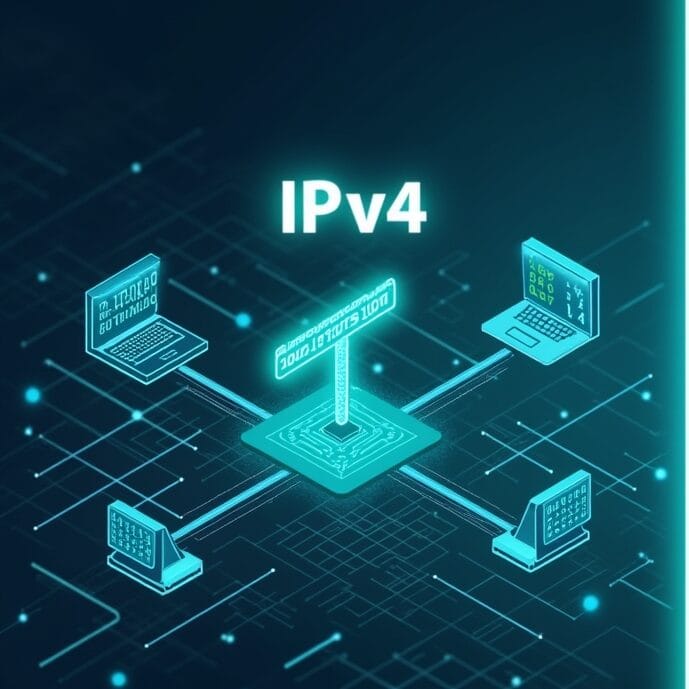
Before we get into the IPv4 vs IPv6 debate, let’s understand what an IP address is.
Think of an IP (Internet Protocol) address as your home address, but for your computer, phone, or gaming console on the internet. When you want to visit a website like InsaneNotes.in, your device needs to know where to find the computer (server) that holds the website’s files. It uses the website’s IP address to find it, just like the postman uses your home address to deliver a letter.
Every single device connected to the internet must have a unique IP address. This is the fundamental rule that makes the global network work. Without these unique identifiers, data wouldn’t know where to go, and the internet would be a chaotic mess.
Meet the Old-Timer: What is IPv4?
IPv4 stands for Internet Protocol version 4. It’s the old, reliable system that has been running the internet since the 1980s. It’s like the trusted family car that’s been running for decades.
An IPv4 address looks like a series of four numbers separated by dots. For example: 192.168.1.1
Each number can range from 0 to 255. So, the structure is: [0-255].[0-255].[0-255].[0-255]
This system created about 4.3 billion unique addresses. In the 1980s, that seemed like more than enough. Who could have imagined that one day, almost every person would have multiple internet-connected devices?
Also Read This
Top 10 High Salary AI Jobs in 2025 | Best Artificial Intelligence Career Options”
The Big Problem with IPv4: We’re Out of Numbers!
The main issue with the IPv4 protocol is simple math. 4.3 billion sounds like a lot, but there are nearly 8 billion people on Earth. With smartphones, laptops, smartwatches, and even smart light bulbs going online, we simply ran out of new IPv4 addresses.
To cope with this, tech experts created clever workarounds, like:
- NAT (Network Address Translation): This lets many devices in your home share the one public IPv4 address given by your Internet Service Provider (ISP). Your router acts like a receptionist, directing traffic to the right device inside your house.
- Dynamic IP Addresses: Instead of giving you a permanent address, your ISP gives you a temporary one from a pool and takes it back when you’re done.
But these are just band-aids, not permanent solutions. They can also make things more complicated and slow down your connection sometimes.
Hello, The Newcomer: What is IPv6?
To solve the address shortage once and for all, the smart people of the internet created IPv6, which stands for Internet Protocol version 6. Think of it as building a massive, futuristic highway next to our old, crowded road.
An IPv6 address looks very different. It uses hexadecimal numbers (which include letters A-F and numbers 0-9) and is separated by colons. For example: 2001:0db8:85a3:0000:0000:8a2e:0370:7334
It might look scary, but it’s just a much, much longer address.
The Superpower of IPv6: An Unimaginable Number of Addresses
How many addresses does IPv6 provide? Let’s just say it’s a number our brains can’t really understand.
IPv6 uses a 128-bit address, compared to IPv4’s 32-bit address. This creates 340 undecillion unique addresses. That’s 340 followed by 36 zeros!
To put it in perspective: IPv6 provides more than 1000 addresses for every single grain of sand on Earth. We will never, ever run out. This is the single biggest advantage in the IPv4 vs IPv6 discussion.
IPv4 vs IPv6: A Head-to-Head Comparison
Let’s break down the key differences between these two protocols in a simple table.
| Feature | IPv4 (The Old System) | IPv6 (The New System) |
|---|---|---|
| Address Length | 32 bits | 128 bits |
| Address Example | 192.168.1.1 | 2001:0db8:85a3::8a2e:0370:7334 |
| Number of Addresses | ~4.3 Billion | ~340 Undecillion (Practically Unlimited) |
| Address Configuration | Often manual or via DHCP (Dynamic) | Often automatic (Plug and Play) |
| Security | Requires add-on security (IPsec) | IPsec security is built-in |
| Speed & Performance | Can be slower due to workarounds like NAT | Generally faster and more efficient |
| Packet Size | Requires fragmenting (breaking) larger packets | Handles larger packets more effectively |
Advantages of IPv6 Over IPv4: It’s Not Just About More Numbers
While the huge number of addresses is the star of the show, the advantages of IPv6 go much further.
- No More NAT (Network Address Translation): With IPv6, every device can have its own unique public IP address. This is a “end-to-end” connection. It’s like every device in your house having its own direct phone line, making connections smoother and better for things like online gaming and video calls.
- Built-In Security: IPv6 was designed with security in mind. It has support for IPsec (a suite of security protocols) built right into its core. While IPv4 can use IPsec, it’s an optional add-on. For IPv6, it’s a standard feature, making the network more secure by design.
- Auto-Configuration: IPv6 devices can automatically configure their own IP addresses when they connect to a network (a feature called Stateless Address Auto-Configuration or SLAAC). It’s truly “plug and play,” making life easier for network administrators.
- Efficiency and Speed: IPv6 has a simpler packet structure, which helps routers process data faster. Without the need for NAT, the journey of data is more direct, which can reduce latency. This means less lag in games and smoother streaming.
- Better for Mobile Devices: IPv6 is more efficient for mobile networks, which is crucial in our smartphone-dominated world. It allows your phone to move between different networks (like from Wi-Fi to mobile data) without dropping its connection.
Also Read This:)
Grok AI Features and Review 2025 – Is Elon Musk’s AI Better Than ChatGPT?
The Future of Internet Protocols: What Does 2026 and Beyond Look Like?
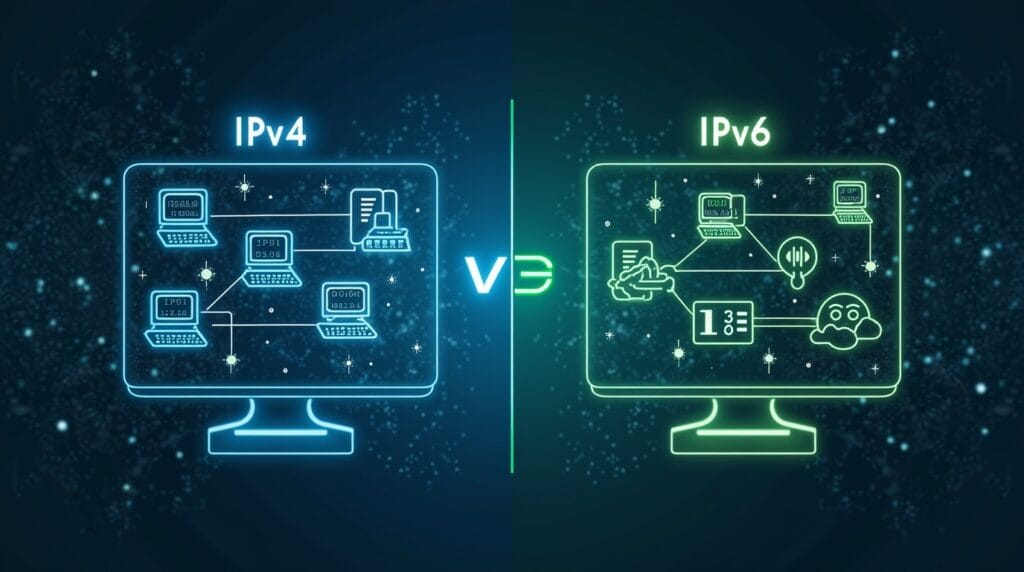
You might be thinking, “If IPv6 is so great, why isn’t everyone using it yet?”
The transition from IPv4 to IPv6 is a massive, slow-moving project—like trying to replace all the water pipes in a giant city without stopping the water supply for a single day. It’s complicated and takes time.
However, the future is undoubtedly IPv6. Here’s what to expect by 2026 and beyond:
- Gradual Phasing Out of IPv4: Major tech companies like Google, Facebook, and Netflix are already using IPv6. As older hardware is replaced, more and more of the internet will become IPv6-native.
- The Rise of IoT (Internet of Things): The world of smart devices—from smart cities and self-driving cars to connected healthcare devices—depends on IPv6. Only IPv6 can provide the countless addresses needed for billions of new sensors and gadgets.
- IPv4 Will Become a Legacy System: IPv4 will not disappear overnight. It will continue to run in the background, supported by “transition technologies” that allow IPv4 and IPv6 to talk to each other. But for new innovations, IPv6 will be the default choice.
- Your Experience Will Improve: As more of the internet shifts to IPv6, you’ll benefit from more stable connections, better security, and a network ready for future technologies we haven’t even imagined yet.
The journey of internet protocol development is an ongoing story, and IPv6 is the next exciting chapter.
Frequently Asked Questions (FAQs)
1. Should I switch to IPv6 at home?
In most cases, yes! If your router and your Internet Service Provider (ISP) support IPv6, it’s a good idea to enable it. It can potentially improve your connection speed and reliability. You can check your router settings or contact your ISP to see if it’s available for you. Most modern devices and operating systems (like Windows, macOS, Android, and iOS) are already IPv6-ready.
2. Is IPv6 faster than IPv4?
It can be. Because IPv6 avoids the extra step of NAT and has a more efficient structure, it can reduce latency, making your internet feel snappier. In many tests, websites and services loaded slightly faster over IPv6. However, the difference might not always be dramatic, but the efficiency gain is real.
3. Will my old devices stop working with IPv6?
Not necessarily. The internet is in a long transition period. Most networks and devices are “dual-stack,” meaning they understand both IPv4 and IPv6. If a device only speaks IPv4, the network will find a way to translate the communication so it still works. However, very old devices that have not received software updates in a decade might face issues eventually.
4. How can I check if I’m using IPv6 right now?
It’s easy! Just visit a website like test-ipv6.com. It will run a simple test and tell you if your connection is using IPv6.
5. Why does my device still have an IPv4 address if we have IPv6?
This is because of “dual-stack” operation, which we mentioned earlier. Your device has both an IPv4 address and an IPv6 address. It uses the IPv6 address to talk to websites and services that support it, and falls back to the IPv4 address for everything else. This ensures you can access the entire internet during this long transition.
Also Read This:)
Top 9 Dark Web Search Engines Link (2025) – Explore Safely with Working .Onion Links
Conclusion: Embracing the New Internet
The IPv4 vs IPv6 story is a perfect example of how technology evolves to meet our growing needs. IPv4 was a brilliant invention that built the internet we know and love. But just like we upgraded from landlines to smartphones, the internet is upgrading to IPv6.
The key differences between IPv4 and IPv6 are clear: IPv6 offers a nearly infinite supply of addresses, better security, improved efficiency, and a solid foundation for the future of technology.
While the shift is happening gradually, understanding this change helps us appreciate the incredible engineering that keeps our digital world running. So, the next time you hear about IPv6, you’ll know it’s not just a technical jargon—it’s the exciting future of the internet, ensuring that everyone and everything can stay connected for generations to come.