Why Python Is the Best Language for Machine Learning
Imagine you’re teaching a robot to tell the difference between a cat and a dog. You wouldn’t use complex, confusing instructions. You’d use simple, clear steps. Now, think of a programming language as the set of instructions you use to talk to computers.
For creating this kind of smart technology, known as Machine Learning (ML), one language has become the superstar, and for good reason. That language is Python.
But why has Python for Machine Learning become such a giant? Is it just a trend, or is there something truly special about it? In this 2026 guide, we will explore the simple, powerful, and enduring reasons why Python is the best friend for anyone stepping into the world of artificial intelligence. We’ll break it all down using easy-to-understand examples, just like we’re explaining it to a friend.
What is Machine Learning, Anyway? Let’s Demystify It!
Before we dive into Python, let’s make sure we understand what Machine Learning really is. Don’t worry; it’s not as scary as it sounds!
In simple terms, Machine Learning is a way of teaching computers to learn from examples and make decisions on their own. Instead of giving it a strict, unchangeable rule like “all cats have pointy ears and whiskers,” you show the computer thousands of pictures of cats and dogs.
The computer, using a special program called a “model,” starts to notice patterns. It might see that cats often have smaller noses or that dogs have longer snouts. It learns these patterns all by itself. The more pictures you show it, the better it gets at telling them apart.
This “learning” process involves a lot of math, statistics, and handling massive amounts of data. A good programming language for this job must make these complex tasks feel simple and manageable. That’s exactly where Python for Machine Learning shines brighter than any other language.
Also Read This
Types of Cables in Networking (2026): Complete Guide with Examples & Uses
The Unbeatable Advantages of Using Python for Machine Learning

Think of Python as a giant, incredibly well-organized toolbox. Everything you need to build something amazing is right inside, neatly labeled, and easy to reach. You don’t need to forge your own hammer or cut down a tree to make a plank. Everything is provided for you.
1. It Reads Like Simple English
The first thing newcomers notice about Python is its clean and straightforward syntax. The code often looks like a set of simple English instructions. This is a massive advantage when you are already dealing with the complex logic of ML.
Let’s see a quick example:
To print “Hello, Machine Learning World!” in another language like Java, you might need to write:
System.out.println("Hello, Machine Learning World!");
In Python, you simply write:)
print("Hello, Machine Learning World!")
This simplicity means you spend less time worrying about semicolons, curly braces, and other confusing symbols, and more time focusing on the actual Machine Learning with Python problem you want to solve. For beginners, this lowers the barrier to entry dramatically.
2. The Powerhouse of Libraries and Frameworks

This is, without a doubt, the single biggest reason for Python’s dominance in the ML field. These libraries are like pre-built, super-powered toolkits for specific jobs. Instead of writing thousands of lines of complex mathematical code from scratch, you can import a library and use its pre-written functions with just a few lines.
This ecosystem is the heart of Python for Machine Learning. Let’s explore the most important ones:
- For Data Wrangling and Analysis:
- Pandas: Think of Pandas as your super-powered Excel spreadsheet inside Python. It lets you load, clean, explore, and manipulate data with incredible ease. Whether your data is in a CSV file or a database, Pandas is the first tool you’ll reach for to get it ready for learning.
- NumPy: This library is the foundation for nearly all numerical computing in Python. It allows you to work efficiently with large arrays and matrices of numbers and performs complex mathematical operations on them at lightning speed. All the other ML libraries are built on top of NumPy.
- For Classic Machine Learning:
- Scikit-learn: This is the ultimate starter kit and workhorse for Machine Learning with Python. It has ready-made, easy-to-use tools for almost every classic ML algorithm you can think of—from linear regression and decision trees to clustering and more. It also provides tools for splitting data, model training, and evaluation, making it a one-stop shop for many projects.
- For Deep Learning and Advanced AI:
- TensorFlow (and its user-friendly interface, Keras): Developed by Google, TensorFlow is a powerhouse for building and training large-scale neural networks. Keras acts as a simple interface to TensorFlow, making it much easier to start building complex models. It’s like having a simple remote control for a giant, powerful robot.
- PyTorch: Developed by Facebook’s AI Research lab, PyTorch is another giant in the deep learning world. Many researchers and developers love it for its flexibility and “Pythonic” style, which feels more intuitive when building and experimenting with new kinds of neural network architectures.
Also Read This
Difference Between var let and const in JavaScript (With Examples 2026)
3. A Global, Helpful, and Friendly Community
When you start your journey in Python for Machine Learning, you are never alone. Because Python is so popular, it has one of the largest and most active programming communities in the world.
What does this mean for you?
- If you get stuck on a problem, someone has almost certainly faced it before. A quick search online will lead you to solutions on platforms like Stack Overflow, GitHub, or Reddit.
- There are thousands of free tutorials, blog posts (like this one on InsaneNotes.in!), video courses, and documentation available.
- You can find pre-built code snippets and entire projects to learn from.
This massive community support system acts as a global team of mentors, making the journey of learning Python for AI much less intimidating and far more collaborative.
4. It’s Versatile and Plays Well with Others
A Machine Learning with Python project is rarely just about the model. You might need to get data from a website (web scraping), connect to a database, or create a simple web application to show off your results.
Python is incredibly versatile. You can use:
- Beautiful Soup or Scrapy for web scraping.
- SQLAlchemy to talk to databases.
- Flask or Django to build web applications.
This means you can manage your entire project—from data collection to deployment—using a single, consistent language. You don’t have to juggle multiple languages for different tasks, which simplifies everything.
Also Read This
Types of Cables in Networking (2026): Complete Guide with Examples & Uses
Python vs. Other Languages: A Simple Comparison
You might have heard of other languages like C++, Java, or R. They are also used in technology, so how does Python stack up? Let’s look at a simple table.
| Feature | Python | Other Languages (C++ / Java) | R |
|---|---|---|---|
| Ease of Learning | Very Easy. Like learning to ride a bicycle with training wheels. Simple, readable syntax. | Harder. Like learning to drive a manual truck. More complex rules and syntax. | Moderate. Great for statistics but has a steeper learning curve for general programming. |
| Speed of Coding | Very Fast. Rapid development thanks to simple syntax and vast libraries. Ideal for quick experiments. | Slower. You often have to write more code to accomplish the same task, leading to longer development time. | Fast for stats. Slow for building large, complex software systems. |
| Libraries for ML | Huge & Dedicated. An unparalleled ecosystem specifically for AI, data science, and ML. | Limited. Has ML libraries, but the selection and ease of use are not as rich as Python’s. | Strong for Analytics. Excellent for statistical analysis and data visualization, but weaker for production-level AI systems. |
| Performance/Speed | Good. The core can be slower, but key libraries (NumPy, TensorFlow) use fast C/C++ underneath. | Excellent. Raw code execution is typically faster, which is critical for performance-intensive applications like game engines. | Slower. Generally not designed for high-performance computing in the same way. |
| Best For | Beginners, rapid prototyping, research, and most real-world ML applications. | Projects where every millisecond of speed is critical (e.g., high-frequency trading, complex game physics). | Deep statistical analysis, academic research focused purely on data exploration and statistics. |
As you can see, for most people—especially beginners and those focused on getting results quickly—using Python for AI is the most sensible, efficient, and powerful choice.
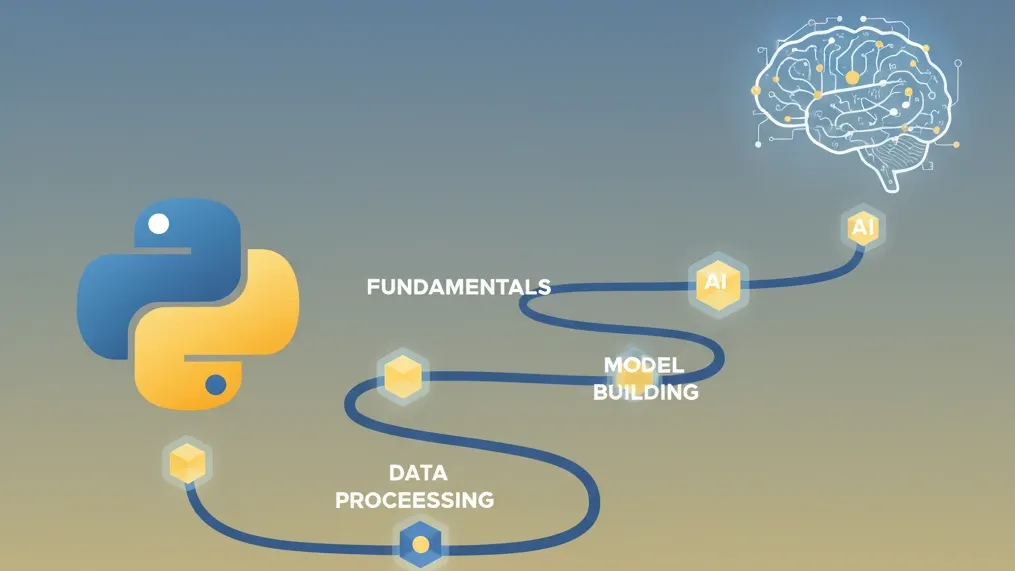
Your Learning Pathway: How to Start with Python for Machine Learning
Feeling inspired? Here’s a simple, step-by-step path you can follow to start your own journey.
- Learn Python Fundamentals: First, get comfortable with the basics of Python itself. You don’t need to be an expert, but you should understand concepts like variables, data types, loops, functions, and conditionals. There are many free interactive tutorials and courses online.
- Dive into the Data Science Stack: Once you know the basics, start practicing with the key libraries we discussed.
- Learn NumPy for numerical operations.
- Master Pandas for data manipulation. This is a crucial skill.
- Use Matplotlib and Seaborn for creating charts and graphs to visualize your data.
- Tackle Machine Learning with Scikit-learn: This is your entry point into real ML. Start with simple models like Linear Regression for predictions and K-Nearest Neighbors for classification. Learn the complete workflow: loading data, cleaning it, training a model, and evaluating its performance.
- Experiment with a Deep Learning Framework: After you’re confident with Scikit-learn, pick one of the big two—either TensorFlow/Keras or PyTorch—and build a simple image classifier or a text generator. Start with their official beginner tutorials.
- Work on Personal Projects: This is the most important step. Think of a simple problem you find interesting. Maybe you want to predict house prices in your city, classify different types of flowers from images, or analyze the sentiment of movie reviews. Building something you care about is the best way to learn.
Also Read This:)
Best 10 AI Tools for Coding in 2026 – Write Code Faster with Artificial Intelligence
Frequently Asked Questions (FAQs)
1. I’m a complete beginner with no coding experience. Can I still learn Machine Learning with Python?
Absolutely! In fact, Python is the most highly recommended first language for a reason. Its simple and readable style allows you to understand the core concepts of ML without getting bogged down by overly complex code rules. Start with the fundamentals, be patient with yourself, and build up step-by-step.
2. People say Python is slow. Is it fast enough for big, real-world machine learning projects?
This is a common and valid question. While the core Python language can be slower than C++, the powerful libraries like NumPy, TensorFlow, and PyTorch are actually written in super-fast languages like C and C++. When you use these libraries, you are writing easy Python commands, but the heavy-duty number crunching happens in the super-fast C++ engine underneath. You get the best of both worlds: the ease of Python with the speed of a racecar.
3. What are the absolute best Python libraries I should learn first for Machine Learning?
For a solid start, focus on this sequence:
- Pandas and NumPy for handling your data.
- Matplotlib/Seaborn for visualizing your data and results.
- Scikit-learn for implementing classic machine learning models.
These four libraries form the foundation for about 80% of all Python for Machine Learning tasks.
4. How much math do I really need to know for Machine Learning with Python?
Having a basic understanding of high-school level algebra (variables, equations) and statistics (mean, median, standard deviation) is very helpful. However, the beauty of libraries like Scikit-learn is that they hide much of the complex math. You can build and use effective models by understanding what the algorithms do conceptually, even if you don’t derive the underlying formulas from scratch. You can always learn the math more deeply as you progress.
5. Will Python still be popular for AI in 2026 and beyond, or is it a passing trend?
All signs point to a resounding yes. Its popularity is not a fluke but is built on a solid foundation of simplicity and a powerful ecosystem. The huge community and continuous development of new, advanced libraries (like the recent Keras 3, which works with both TensorFlow and PyTorch) ensure that Python for Machine Learning will remain the dominant and most practical choice for the foreseeable future. Investing your time in learning it is a safe and smart bet.
Also Read This
Top 10 High Salary AI Jobs in 2025 | Best Artificial Intelligence Career Options”
Conclusion: Your AI Journey Starts Here
So, there you have it. Python for Machine Learning is like the perfect partnership. Python is the friendly, easy-to-understand guide, and Machine Learning is the exciting, intelligent frontier. Together, they form an unbeatable combination that is actively shaping our future.
From its simple syntax that feels like reading English to its incredible collection of pre-built tools and the global community that has your back, Python removes the obstacles and lets your creativity and problem-solving skills take center stage.