Remote Working India 2025: The Complete Guide to India’s Work-from-Anywhere Revolution
1. Introduction
Remember when “going to the office” meant spending hours in traffic, away from family, and sticking to a rigid 9-to-5 schedule? That concept is being rewritten across India. Remote working, once an emergency measure during the COVID-19 pandemic, has blossomed into a permanent, transformative shift in how we approach work. Thanks to advancements in technology—from widespread 5G connectivity to intuitive AI tools—millions of Indian professionals can now work from anywhere, turning their homes, local cafés, or co-working spaces into productive offices.
This shift is not just about location; it’s about flexibility, productivity, and a better quality of life. In 2025, this evolution has reached a tipping point. Companies have moved from simply allowing work-from-home to building comprehensive strategies for distributed teams. This article will guide you through the journey, current landscape, and future of Remote Working India 2025, offering insights for both beginners exploring this model and professionals looking to optimize their remote work experience.
2. The Evolution of Remote Work in India
The journey of remote work in India is a story of rapid adaptation. The timeline below captures the key milestones that have shaped the remote work landscape in the country.
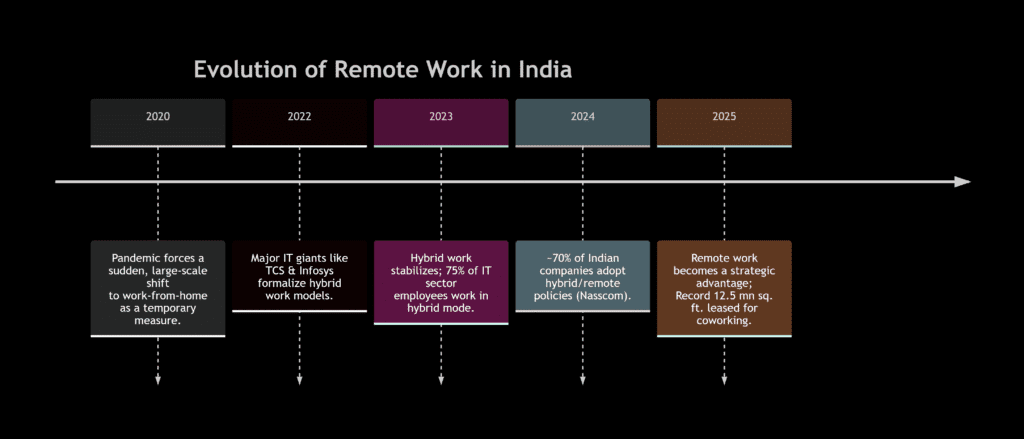
Initially, both companies and employees faced hurdles, including unreliable internet, a lack of digital collaboration tools, and traditional managerial mindsets that equated physical presence with productivity. However, as investments in digital infrastructure grew and people adapted, the benefits became undeniable.
The period from 2023 to 2025 marked a significant turning point, with the hybrid model—splitting time between the office and home—becoming the most common arrangement . This era of Remote Working India 2025 is characterized by structured policies, technological maturity, and a focus on outcomes rather than hours clocked.
3. Why Remote Working is Booming in 2025
Several powerful factors have converged to make remote work a mainstream reality in India this year.
- Improved Digital Infrastructure: The aggressive rollout of 5G and affordable high-speed internet has been a game-changer, especially in Tier-2 and Tier-3 cities. This has been supported by the government’s continued push for its Digital India campaign, aiming to make technology accessible to all .
- Affordable Technology: The market is flooded with cost-effective collaboration tools and cloud services. Indian HR tech platforms like Keka and Darwinbox have made managing remote teams seamless and affordable for businesses of all sizes .
- Proven Productivity Gains: The initial fear that remote work would hamper productivity has been put to rest. A Stanford study found a 13% increase in productivity when working from home, with other reports showing gains of up to 47% . This data has given companies the confidence to fully embrace remote models.
- The AI Productivity Boost: AI tools have become indispensable virtual assistants. Professionals are using platforms like Notion AI for writing and organization, ChatGPT for brainstorming and coding, and Grammarly for communication clarity, making distributed work more efficient than ever .
- Strong Employee Preference: Flexibility is now a key factor for job seekers. A telling statistic from a 2025 report reveals that 50-60% of remote workers would consider quitting if forced back to the office full-time . To attract and retain top talent, companies have no choice but to offer flexible work options, cementing the trend of Remote Working India 2025.
4. Top Industries Adopting Remote Work in India
While remote work has permeated various sectors, some industries have led the charge due to the digital nature of their work.
Information Technology (IT) & Software
The IT sector was the pioneer and remains the largest adopter of remote and hybrid models. From software developers and testers to project managers, most roles can be performed effectively from anywhere. Giants like TCS and Infosys have established formal hybrid models, and many startups have embraced a “remote-first” culture . The success of Remote Working India 2025 in this sector is a blueprint for others.
Digital Marketing & Content Creation
This field is inherently suited for remote work. Freelancers and agencies use tools like Canva for design, ChatGPT for content ideation, and social media management platforms to run campaigns for global clients from their home offices. This has democratized opportunities for creatives across the country.
Education & E-Learning
The education sector has been transformed. Online tutors, course creators, and e-learning platforms now reach students in the remotest corners of the country. This shift has not only continued post-pandemic but has expanded, making quality education more accessible and creating a new wave of remote teaching jobs.
Customer Support
Modern BPOs and customer support centers are no longer limited to large office buildings. With secure cloud-based systems and AI-powered chatbots, support agents can resolve queries from home. This has also allowed companies to tap into a wider, multilingual talent pool across different states. The infrastructure supporting Remote Working India 2025 has been vital for this sector’s transition.
5. Essential Tools and Technologies for Remote Work
The right toolkit is the backbone of an effective remote work setup. Here are the essential categories of tools that Indian professionals and companies are using in 2025:
Table: Essential Remote Work Tools in India (2025)
Mastering these tools is crucial for anyone participating in the ecosystem of Remote Working India 2025. They bridge the physical gap between teams, ensure smooth workflows, and maintain a sense of connection and shared purpose.
6. Benefits of Remote Working for Indians
The shift to remote work is more than a trend; it’s a movement that is delivering tangible benefits to Indian professionals and the economy.
- Flexibility and Better Work-Life Balance: The most celebrated advantage is control over one’s schedule. Remote work eliminates draining daily commutes, saving the average Indian professional about 55 minutes per day . This reclaimed time can be invested in family, hobbies, or rest, leading to a healthier, more sustainable lifestyle.
- Significant Cost Savings: Employees save money on fuel, public transport, car maintenance, and expensive office attire. Collectively, remote workers in India save billions of rupees, with estimates suggesting individual savings can average $2,000 (approx. ₹1.6 Lakh) per year . Employers also save massively on real estate, electricity, and operations.
- Opportunities for Tier-2 and Tier-3 Cities: Remote work has democratized geographic opportunity. A talented graphic designer in Jaipur can now work for a startup in Bangalore or a company in the US without leaving her hometown. This has reduced migration to overcrowded metros and is spurring economic growth in smaller cities . This geographic decentralization is a core success of Remote Working India 2025.
- Increased Autonomy and Productivity: Freed from the distractions of a noisy office, many professionals find they can focus better and produce higher-quality work. The shift to an outcome-based evaluation model also empowers employees to manage their own time and work in the way that suits them best, boosting motivation and engagement .
7. Challenges and Practical Solutions
Despite its many advantages, remote work comes with its own set of challenges. Fortunately, for each problem, there is an emerging solution.
Table: Common Remote Work Challenges and Their Solutions in India
8. The Future of Remote Working India 2025 and Beyond
The evolution of remote work is far from over. As we look beyond 2025, several exciting trends are set to define the next chapter.
- The Dominance of Hybrid Models: The future is not necessarily fully remote, but flexibly hybrid. Most companies are expected to settle into a rhythm that blends the collaboration of the office with the focus of remote work, offering employees the best of both worlds .
- Deeper AI Integration: AI will move beyond being a helper to becoming a core part of the work fabric. AI will automate repetitive tasks, provide predictive analytics for projects, and even help in managing team morale by analyzing engagement patterns.
- The Growth of the Gig Economy: Remote work is closely tied to the rise of project-based gig professionals. The gig economy in India is projected to grow by 30-35% annually , allowing businesses to tap into specialized talent for specific needs and giving professionals unprecedented autonomy.
- Smarter Workspaces – The Coworking Boom: The demand for flexible, professional workspaces close to home will surge. In 2024, a record 12.5 million square feet was leased by coworking operators in India . These spaces will evolve into community hubs that offer networking and learning opportunities, blurring the lines between home, office, and social club.
The landscape of Remote Working India 2025 is dynamic and full of potential, pointing towards a future that is more flexible, inclusive, and digitally empowered.
9. Conclusion
The journey of remote work in India from a temporary fix to a strategic mainstay in 2025 is a powerful testament to the resilience and adaptability of its workforce and businesses. This shift is fundamentally reshaping the Indian professional landscape, offering unparalleled flexibility, unlocking talent from geographic constraints, and fostering a new culture of trust and outcome-oriented work.
While challenges like connectivity, isolation, and maintaining boundaries are real, they are being met with innovative solutions, from robust HR policies and tech tools to the growing network of co-working spaces. The future of Remote Working India 2025 is bright, leaning towards intelligent hybrid models, a thriving gig economy, and workspaces designed for human connection and well-being.
Whether you are an employee aspiring for a better work-life balance or a professional in a small town seeking global opportunities, the time to embrace this change is now. Invest in learning new digital collaboration tools, proactively manage your well-being, and stay adaptable. The future of work is not a place—it’s an outcome you can deliver from anywhere. Start your journey in the world of Remote Working India 2025 today